
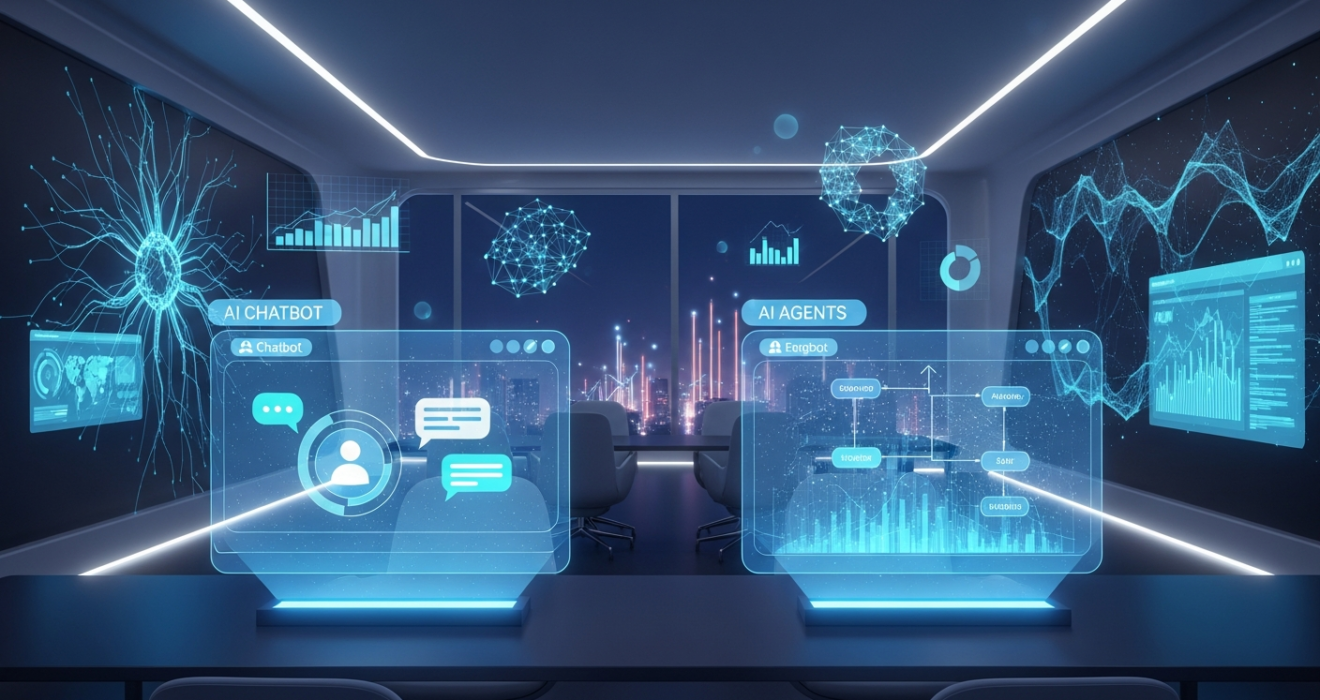
AI Chatbots vs AI Agents What’s the Difference
Here’s something most businesses are getting wrong right now: they think all AI that talks to customers is essentially the same. They hear “chatbot” and assume it covers everything from a simple FAQ bot to a complex system that can practically run itself. But that’s like saying a bicycle and a self-driving car are both just “transportation.” While technically true, the difference in capability and impact is monumental.
Understanding the fundamental distinction between AI chatbots and AI agents isn’t just a technicality; it’s a strategic imperative. It dictates how you interact with customers, automate tasks, and ultimately, where your business can truly find growth in the coming years. If you’re looking to leverage artificial intelligence for more than just basic customer service, this difference is your starting point.
So, let’s break down the core differences, explore their capabilities, and see how they can shape your business future.
AI Chatbots vs. AI Agents: The Core Distinction
At their heart, both AI chatbots and AI agents are designed to interact with humans or systems using artificial intelligence. However, their scope, autonomy, and purpose diverge significantly. Think of it as a spectrum of intelligence and initiative.
What is an AI Chatbot?
An AI chatbot is primarily a conversational interface. Its main goal is to simulate human conversation, typically to answer questions, provide information, or perform simple, predefined tasks. Chatbots are reactive; they wait for a user prompt, process it based on their programming (rules-based or machine learning models), and then provide a response.
- Reactive: Responds to user input.
- Limited Scope: Primarily conversational, focused on specific inquiries.
- Defined Path: Often follows pre-set rules or conversational flows.
- Example: A website bot answering FAQs about product features or a messenger bot taking a simple order.
What is an AI Agent?
An AI agent, on the other hand, is a more sophisticated entity. It’s designed to understand context, set goals, plan actions, execute those actions (often autonomously), and learn from its experiences to achieve specific objectives. AI agents are proactive; they don’t just wait for questions but actively work towards a defined outcome, often involving multiple steps, systems, and decision-making points.
- Proactive: Initiates actions to achieve a goal.
- Broad Scope: Can perform complex tasks, make decisions, and interact with multiple systems.
- Autonomous & Adaptive: Plans its own steps and learns over time.
- Example: An AI marketing agent that identifies customer churn risk, designs a personalized retention campaign, initiates an email sequence, and monitors its effectiveness.
The Direct Answer: What’s the fundamental difference between an AI chatbot and an AI agent?
The fundamental difference lies in their autonomy and initiative. AI chatbots are reactive conversational tools designed to answer questions or follow predefined scripts. AI agents are proactive, goal-oriented systems that can autonomously plan, execute, and learn from multi-step actions to achieve complex objectives, often without direct human intervention.
The Autonomy Spectrum: Where Your Business Truly Grows
When considering AI for your business, it’s helpful to visualize the “Autonomy Spectrum.” On one end, you have the basic chatbot – an intelligent interface. On the other, the sophisticated AI agent – a true digital colleague capable of independent work.
When to Deploy an AI Chatbot
Chatbots are excellent for:
- First-Line Customer Support: Handling common questions, freeing up human agents for complex issues.
- Information Retrieval: Quickly providing data from a knowledge base.
- Basic Lead Qualification: Asking initial questions to gather user intent.
- Simple Transactions: Booking appointments, resetting passwords, ordering predefined items.
Think of them as highly efficient digital receptionists or information desks. They excel at repetitive, high-volume tasks that don’t require deep context or complex decision-making.
Unlocking Potential with AI Agents
AI agents, however, are where the truly transformative potential lies for businesses ready to move beyond basic automation. They are suitable for scenarios requiring:
- Proactive Customer Engagement: Identifying a customer need before they express it and acting on it.
- Complex Workflow Automation: Orchestrating tasks across different software systems without human triggers.
- Personalized Marketing Campaigns: Designing, executing, and optimizing entire campaigns for individual customer segments.
- Data Analysis and Insight Generation: Monitoring market trends, identifying opportunities, and even recommending strategies.
- Supply Chain Optimization: Predicting demand, managing inventory, and dynamically adjusting logistics.
Imagine an AI agent managing your entire lead nurturing process, from initial contact to qualified handover, learning and optimizing every step. That’s a significant leap from a bot just answering a “what’s your price?” question.
Real-World Impact: A Tale of Two AI Deployments
Consider two fictional businesses, both embracing AI:
Scenario 1: The E-commerce Chatbot
“QuickCart” implemented an AI chatbot on its product pages. When customers asked about shipping times or return policies, the bot instantly provided answers, reducing calls to customer service by 20%. It was efficient, helpful, and improved basic customer experience. A solid win for efficiency.
Scenario 2: The Proactive AI Marketing Agent
“GrowthEdge Solutions,” a SaaS company, deployed an AI agent. This agent monitored user behavior within their software, identified patterns indicating potential churn (e.g., declining feature usage, ignored update notifications), and proactively intervened. It would then generate personalized content, craft a tailored email offering a specific feature walkthrough or a limited-time incentive, and schedule a follow-up if engagement didn’t improve. It even integrated with their CRM to alert a human sales rep for high-value accounts. The result? A 15% reduction in churn and a significant boost in feature adoption. This isn’t just answering questions; it’s driving strategic outcomes.
The difference is clear: one responds to existing needs, the other anticipates and acts on potential opportunities or threats.
The Future is Agent-Driven (and Human-Guided)
As we look towards 2026 and beyond, the evolution from chatbots to AI agents is not just a trend; it’s the foundation of future digital operations. Generative AI is rapidly enhancing the capabilities of both, making chatbots more conversational and agents more powerful in their ability to create and execute.
The rise of AI agents means businesses will need fewer human hands for repetitive operational tasks and more human minds for strategic oversight, ethical considerations, and managing these sophisticated systems. This shift requires a new breed of professionals who understand not just AI, but how to strategically apply it for business growth.
This is precisely why understanding the strategic implementation of AI is crucial. As an AI digital marketing consultant and growth strategist, I see firsthand how businesses that grasp this distinction are the ones poised for significant advantage. It’s about more than just adopting technology; it’s about architecting your future with intelligent systems.
Are You Ready for AI Agents? A Quick Checklist
- Do you have complex, multi-step processes that could benefit from automation?
- Are you looking for proactive solutions rather than just reactive responses?
- Do you need personalized interactions at scale that go beyond simple FAQs?
- Is your team prepared to manage and oversee autonomous AI systems?
- Are you collecting enough data to feed an AI agent for learning and optimization?
- Are you open to redefining roles where AI handles execution and humans focus on strategy?
If you answered yes to several of these, it’s time to start exploring the world of AI agents. And for those looking to build the skills to leverage these powerful tools, foundational knowledge from an AI digital marketing institute can provide the necessary edge.
Frequently Asked Questions
What are the primary benefits of using an AI chatbot?
AI chatbots primarily offer benefits in efficiency and immediate response. They can handle a high volume of routine inquiries 24/7, reduce customer service costs, improve customer satisfaction by providing instant answers, and free up human agents to focus on more complex or sensitive issues.
How can AI agents specifically drive business growth?
AI agents drive growth by enabling proactive, intelligent automation across various functions. They can personalize customer journeys, optimize marketing campaigns for better ROI, automate sales processes, reduce operational costs through sophisticated workflow management, and provide deeper, actionable insights from data, leading to competitive advantage and new revenue streams.
Are AI agents only for large enterprises, or can small businesses use them?
While often associated with large enterprises due to their complexity, AI agent capabilities are becoming increasingly accessible to small and medium-sized businesses. Cloud-based platforms and modular AI services are lowering the barrier to entry, allowing smaller players to automate specific, goal-oriented tasks without massive upfront investment, focusing on areas like personalized outreach or lead scoring.
What skills are needed to manage and implement AI agents effectively?
Managing AI agents effectively requires a blend of technical and strategic skills. These include understanding AI ethics, data analysis, prompt engineering, basic project management for AI implementations, and a strong grasp of business strategy to define clear objectives for the agents. Continuous learning and adaptability are also key, as AI technology evolves rapidly.
What are the ethical considerations when deploying AI agents?
Ethical considerations for AI agents are paramount. These include ensuring transparency in AI decision-making, mitigating biases in data and algorithms, safeguarding user privacy, establishing clear accountability for agent actions, and preventing misuse that could harm individuals or society. Businesses must implement robust ethical guidelines and oversight mechanisms.
The distinction between AI chatbots and AI agents isn’t just semantic; it’s strategic. While chatbots excel at reactive communication, AI agents empower businesses with proactive, autonomous action, opening doors to unprecedented efficiency, personalization, and growth.
Embracing AI agents means reimagining your operations and customer interactions, moving beyond simple automation to intelligent orchestration. As an AI Digital Marketing Consultant & Growth Strategist, my perspective is clear: mastering this difference is no longer optional, but essential for future-proofing your business in an increasingly AI-driven world. It’s about leveraging these tools not just for tasks, but for transformation.
Ready to explore how AI agents can revolutionize your business strategies and drive tangible growth? Let’s connect and chart a course for your AI journey.